Cooling towers play an important role in many commercial and industrial buildings. They help remove excess heat from HVAC and industrial systems, allowing equipment to operate efficiently and maintain comfortable indoor conditions.
Understanding how a cooling tower works helps building owners identify maintenance needs, improve system performance, and manage energy costs.
What Is a Cooling Tower?
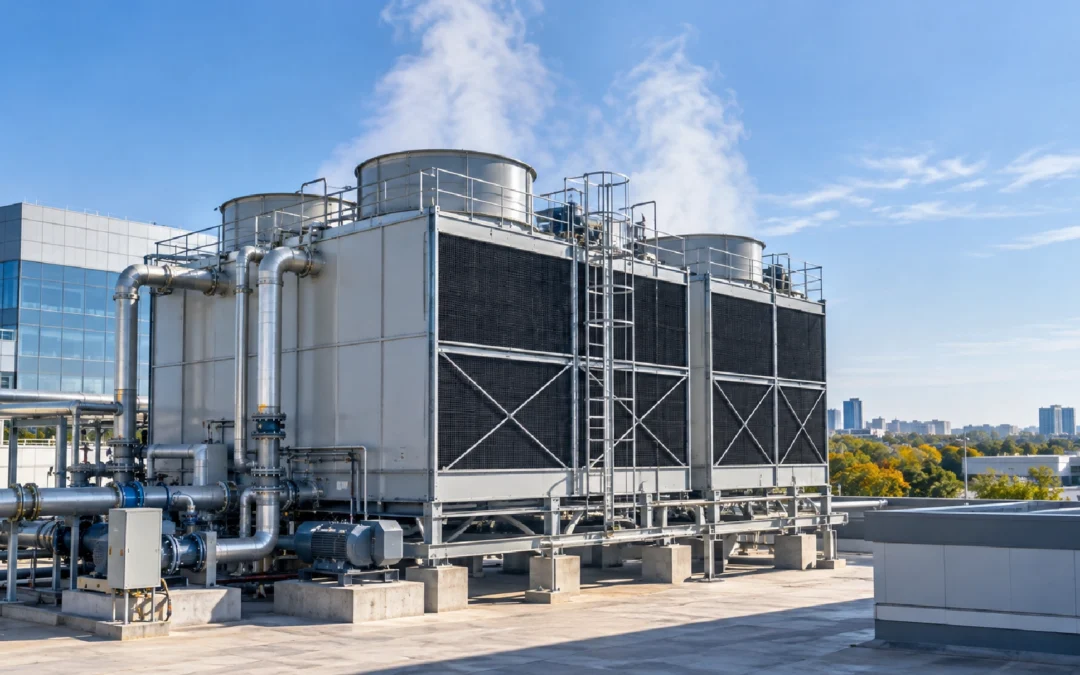
A cooling tower is a heat-rejection system that removes heat from water used in commercial HVAC or industrial processes. Heated water enters the tower and is exposed to air. A small portion of the water evaporates, carrying heat away from the system.
The cooled water is then returned to the building’s cooling system to absorb more heat.
How Does a Cooling Tower Work?
The basic cooling tower process involves several steps:
- Warm water enters the cooling tower after absorbing heat from the building or equipment.
- Water is distributed over fill material inside the tower.
- Fans or natural airflow move air through the tower.
- A small amount of water evaporates, removing heat from the remaining water.
- Cooled water collects in the basin.
The cooled water is pumped back into the system.
This continuous cycle allows the cooling system to reject unwanted heat efficiently.
What Are the Main Components of a Cooling Tower?
A cooling tower consists of several important components that work together.
Fill Material
Fill increases the surface area available for water and air to interact, improving heat transfer.
Fans
Mechanical-draft cooling towers use fans to move air through the system and support evaporation.
Water Distribution System
Nozzles or other distribution equipment spread warm water across the fill material.
Basin
The basin collects cooled water before it is circulated back through the cooling system.
Drift Eliminators
Drift eliminators help reduce the amount of water droplets carried out of the tower with the exhaust air.
Types of Cooling Towers
Commercial buildings commonly use different cooling tower designs based on their application and available space.
Open-Circuit Cooling Towers
These systems circulate water directly through the tower, where it comes into contact with moving air.
Closed-Circuit Cooling Towers
Closed-circuit systems keep the process fluid inside coils while water and air provide the cooling effect outside the coils.
Mechanical-Draft Cooling Towers
These towers use fans to control airflow and provide consistent cooling performance.
Why Cooling Tower Maintenance Matters
Regular maintenance is important for reliable cooling tower operation. Dirt, scale, corrosion, biological growth, and worn components can reduce efficiency and affect performance.
Routine maintenance can help:
- Improve heat-transfer efficiency
- Reduce energy consumption
- Prevent unexpected breakdowns
- Extend equipment life
- Maintain reliable cooling performance
Signs Your Cooling Tower Needs Service
Building owners should watch for changes in cooling tower performance. Warning signs may include unusual noises, poor cooling, excessive water loss, visible scale or corrosion, and increased energy consumption.
Addressing these issues early can help prevent more costly repairs and downtime.
Why Choose East Coast Renewable Energy for Cooling Tower Services?
At East Coast Renewable Energy, we provide reliable energy and equipment solutions for commercial properties. Our team can help businesses evaluate cooling tower performance, identify efficiency concerns, and determine appropriate service or improvement options.
We focus on practical solutions that help commercial facilities improve system performance, manage energy use, and maintain reliable operations.
Get a Free Estimate for Cooling Tower Services
Is your commercial cooling system operating inefficiently? Contact East Coast Renewable Energy today for a free estimate. Our team can help evaluate your cooling tower and recommend solutions designed around your building’s needs.