
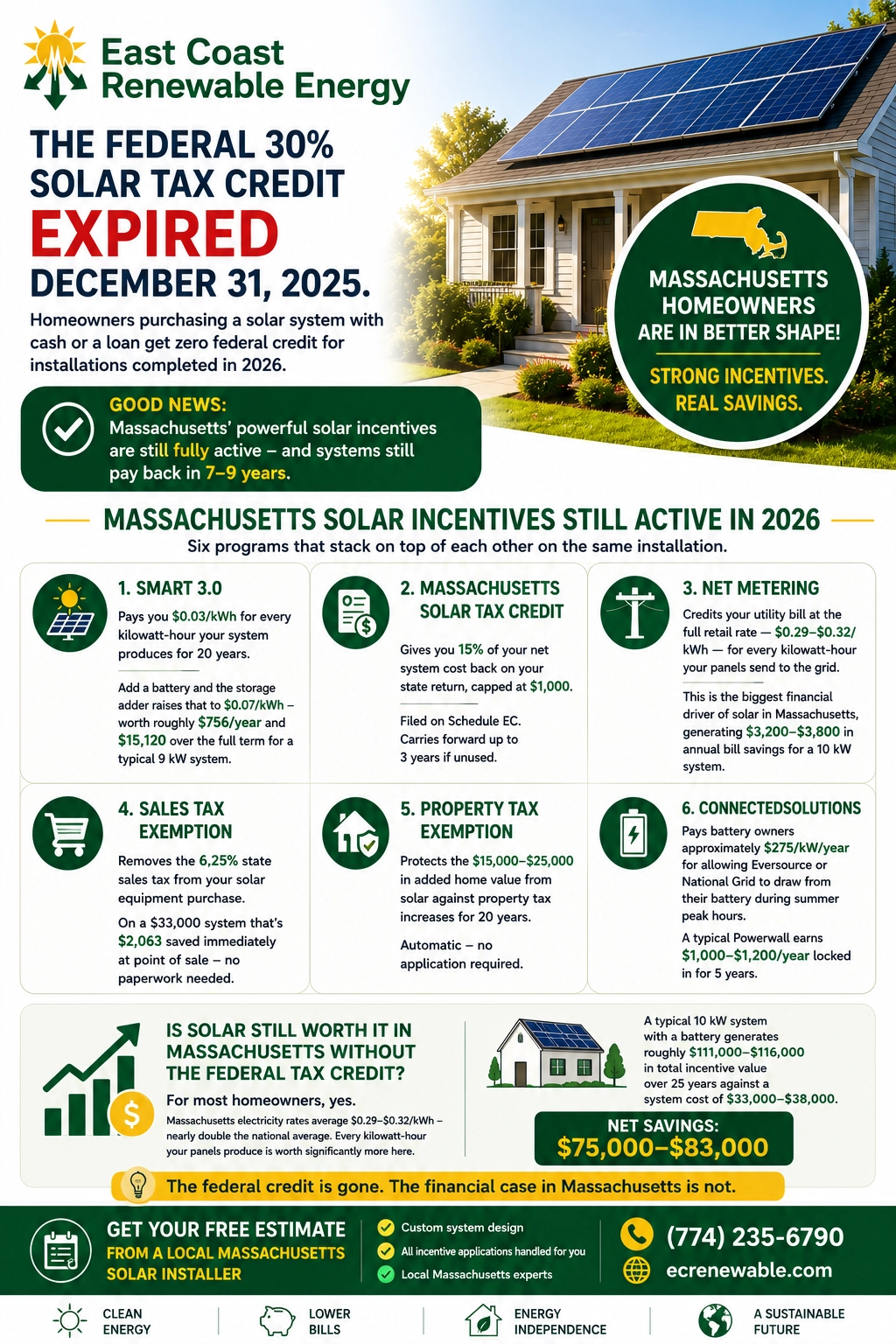
The federal 30% residential solar tax credit expired December 31, 2025. No renewal, no extension. Homeowners purchasing a solar system with cash or a loan get zero federal credit for installations completed in 2026.
But Massachusetts homeowners are in better shape than most. The state’s solar incentive stack was already substantial before the federal credit existed – and everything except Section 25D is still fully active. Most systems still pay back in 7–9 years.
Here’s exactly what you can still claim.
Massachusetts Solar Incentives Still Active in 2026
Six programs survived the federal credit expiry – and they stack on top of each other on the same installation:
SMART 3.0 pays you $0.03/kWh for every kilowatt-hour your system produces for 20 years. Add a battery and the storage adder raises that to $0.07/kWh – worth roughly $756/year and $15,120 over the full term for a typical 9 kW system.
Massachusetts solar tax credit gives you 15% of your net system cost back on your state return, capped at $1,000. Filed on Schedule EC. Carries forward up to 3 years if unused.
Net metering credits your utility bill at the full retail rate — $0.29–$0.32/kWh — for every kilowatt-hour your panels send to the grid. This is the biggest financial driver of solar in Massachusetts, generating $3,200–$3,800 in annual bill savings for a 10 kW system.
Sales tax exemption removes the 6.25% state sales tax from your solar equipment purchase. On a $33,000 system that’s $2,063 saved immediately at point of sale – no paperwork needed.
Property tax exemption protects the $15,000–$25,000 in added home value from solar against property tax increases for 20 years. Automatic – no application required.
ConnectedSolutions pays battery owners approximately $275/kW/year for allowing Eversource or National Grid to draw from their battery during summer peak hours. A typical Powerwall earns $1,000–$1,200/year locked in for 5 years.
Is Solar Still Worth It in Massachusetts Without the Federal Tax Credit?
For most homeowners, yes. Massachusetts electricity rates average $0.29–$0.32/kWh — nearly double the national average. Every kilowatt-hour your panels produce is worth significantly more here than in a low-rate state, which is why the remaining incentive stack still delivers strong returns.
A typical 10 kW system with a battery generates roughly $111,000–$116,000 in total incentive value over 25 years against a system cost of $33,000–$38,000. Net savings: $75,000–$83,000.
The federal credit is gone. The financial case in Massachusetts is not.
Get Your Free Estimate from a Local Massachusetts Solar Installer
East Coast Renewable Energy handles every SMART application, net metering enrollment, and incentive filing for every customer across Massachusetts.